
Drywall patching in Menomonee Falls
A hole gets cut out, replaced and finished flat. Nothing fancy. It just has to be done right.
Get a free estimate
The short of it
There are two kinds of drywall patch. The kind you can see, and the kind you cannot. The difference is not talent. It is steps.
The patch you can see was stuck on, filled once and painted. The patch you cannot see was cut square, backed, taped and coated three times. We do the second kind.
How it is done
Damaged drywall is cut back to a clean rectangle. Backing goes in behind the opening so the new piece has something solid to screw to. A piece of matching thickness is fitted flush.
The seams are taped. Then compound goes on in three coats, each wider than the last, until the edge is feathered out a foot or more. Sand, match the texture, done.
Common holes
Door handle
Right at knob height.
Plumber or electrician
Access cuts after a repair.
Wall mounts
TV brackets and shelves that came down hard.
Old fixtures
Thermostats, vents, speakers, jacks.
Accidents
We do not ask.
Steps
Cut
Square it up.
Back
Support behind the wall.
Fit
New drywall, screwed flush.
Tape and coat
Three coats, feathered.
Sand and texture
Blend to the wall.
Why patches fail
No backing. The piece flexes and the edge cracks. No tape. Same result. Too little feathering. The patch sits proud and catches the light. Wrong thickness. It sits low and shows as a dip.
Each of those is avoidable, and none of them costs much to avoid. It is just a matter of not skipping them.
The result
Flat
No hump under the paint.
Solid
Will not crack loose.
Matched
Same texture as the wall.
Quick
Small jobs are in and out.
What the estimate lists
Even a small job gets a written estimate. For patching it is short, and it covers these points.
Count and size
How many patches, and roughly how big each is. A list of ten is priced as one job, not ten.
Location
Wall or ceiling, and anything awkward about the access, such as a stairwell.
Method
Fill only for small holes. Cut out, back and replace for anything larger.
Texture
Smooth, or matched to the wall. If matched, the texture type is noted.
Visits
One or two. So you know how many times someone will be at the door.
Paint
Not included. The patch is left sanded and ready for primer.
Most patch work can be estimated from photos. Put something in the picture for scale and take a second shot from farther back so the wall texture is visible.
How the visits run
Visit one, first hour
Floor protected below the work. Damage cut back to a clean rectangle. Backing screwed in behind the opening. New piece cut and fitted flush.
Visit one, second hour
Seams taped. First coat of setting compound, which hardens in under an hour. Second coat over it, wider.
Between visits
The compound finishes curing. Leave it alone. No need for fans on a small patch in a heated house.
Visit two
Final coat, feathered a foot or more past the patch. Once dry, sanded smooth. Texture applied and blended if the wall has one. Area wiped down and vacuumed.
A very small patch on a smooth wall can sometimes be finished in one long visit. Textured walls and ceilings nearly always need two.
After that it is yours to prime and paint. Prime the patch first. Then paint the wall corner to corner if the existing paint is more than a year or two old.
What we need from you
Photos first. One close, with a hand or a coin for scale. One from across the room so the texture and the position on the wall are clear. That is usually enough to price the job.
The cause. A doorknob, a moving accident and a plumber's access hole are all finished once patched. A hole from a leak is not, until the leak is fixed and the cavity is dry. Tell us which it is.
A few feet of clear space around each patch. Take down pictures and move furniture back. We cover the floor below.
The whole list. If there are other dings, pops or holes in the house, add them. The trip and the setup are the same for one patch or ten.
What can change the plan
What is in the wall. Cutting a hole square sometimes shows a pipe, a cable or a duct right behind it. That changes where the backing can go. It rarely changes the price, but it is why we cut carefully and look before we screw.
Old repairs nearby. If the hole is next to an earlier patch that was built up thick, the new work has to blend into that as well. We may suggest redoing the old one at the same time.
Texture that will not match. Most do. Some hand-applied patterns, and any texture that has been painted many times, are hard to copy over a small area. Where that is the case we say so and offer to retexture a larger section so the change is not visible.
Torn paper around the hole. Pulled anchors and removed fixtures often take the face paper with them. The torn area has to be sealed and skimmed, which makes the repair wider than the hole.
Mistakes we see on patches
Stick-on mesh on a large hole
It sits proud of the wall and has nothing behind it. Fine for a hole the size of a coin. Not for one the size of a fist.
Spackle where compound is needed
Spackle is for nail holes. It shrinks and cracks in anything bigger.
One thick fill
Leaves a dish. Three thin coats stay flat.
Sanding the patch only
The edge needs feathering out wide, or it shows as a square.
After we leave
Prime, then paint. A spot of primer over the patch is the step that stops it flashing through. If you have the original wall paint and it is recent, you may be able to paint just the repaired area. If the paint is older, do the whole wall, corner to corner.
If a door handle made the hole, fit a stop. If an anchor pulled out, remount into a stud or use blocking. Otherwise the same spot takes the same hit.
Notes from the job
Board thickness has to match. Most walls are half-inch. Some ceilings and garage walls are five-eighths. Older houses sometimes have three-eighths. A patch cut from the wrong thickness sits proud or low, and no amount of compound hides it well. We measure at the cut edge.
Holes around electrical boxes are common after a fixture swap. If the gap is too wide for the cover plate to hide, it gets filled with setting compound and taped tight to the box. Oversized cover plates are a quick alternative. We will tell you when one of those is the sensible answer.
Corners are different. A hole within a few inches of an inside or outside corner means the corner itself has to be rebuilt as part of the patch. Outside corners need a section of new bead. That takes a little longer than a patch in open wall.
Plaster walls can be patched with drywall. The thickness is built up to match, and the joint between old plaster and new board is reinforced, since it is the place most likely to crack. Tell us if the house has plaster so we bring the right materials.
Rental and for-sale properties are a large share of patch work. One visit to cut and coat, one to finish, and the unit is ready for the painter.
Before and after
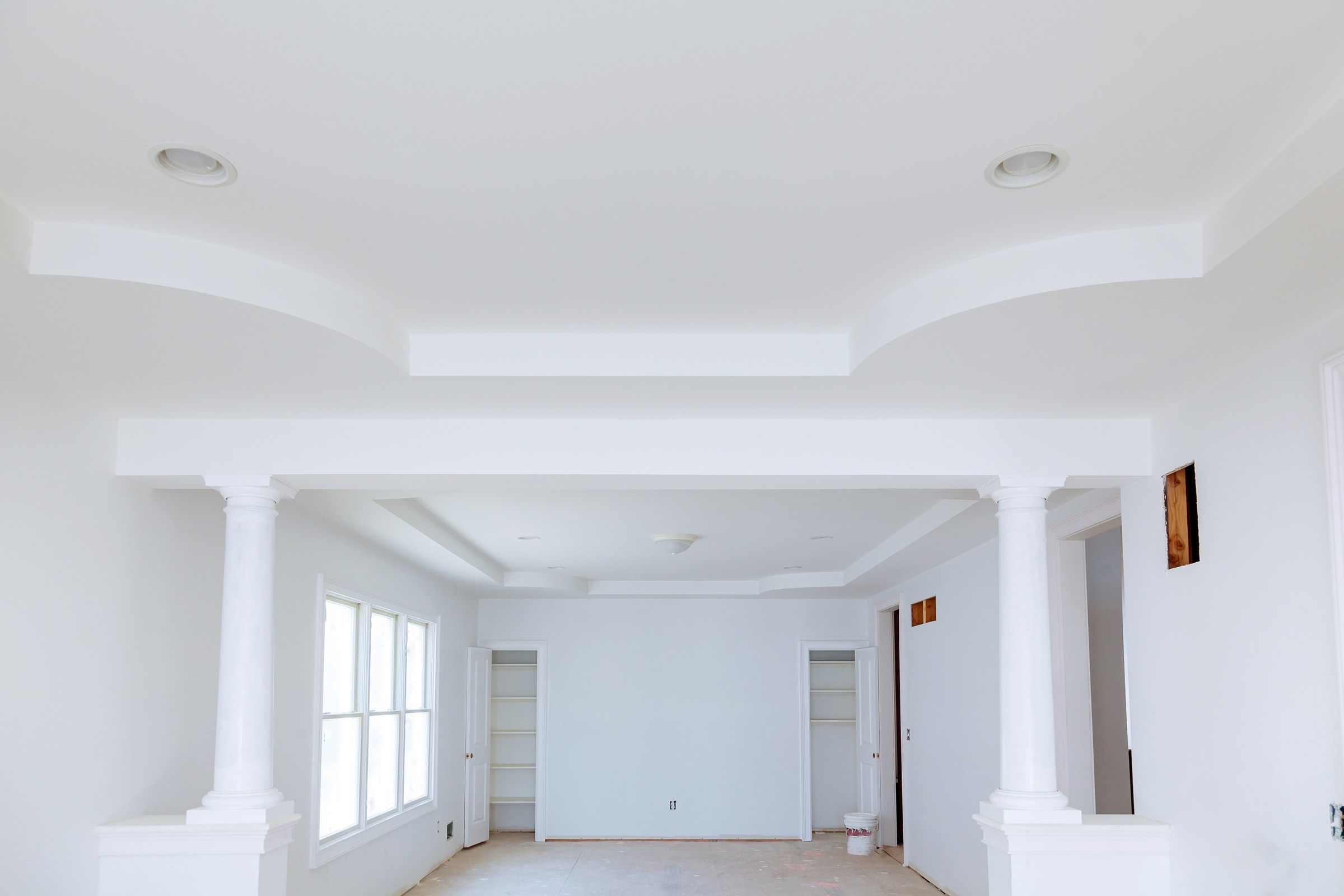
Stock photos, shown to illustrate the result. Not one of our jobs.
Patching in the village
A lot of our patch work follows other trades. Older Falls homes are getting new wiring, new plumbing and new ductwork, and every one of those jobs leaves holes.
Call us when the other trades are finished. We close up after them.
Questions
Can you quote from a photo?
Usually. Put a tape measure or a hand in the shot for scale.
Will the patch show?
Not after the whole wall is painted. Spot-painting just the patch often shows.
How soon can I paint?
The day after we finish, once primed.
Do you patch ceilings?
Yes. Same method.
What about lots of small holes?
We do them all in one visit. It is the cheapest way.
Need a price on drywall patching?
Send the details. You get a written estimate back, free.